
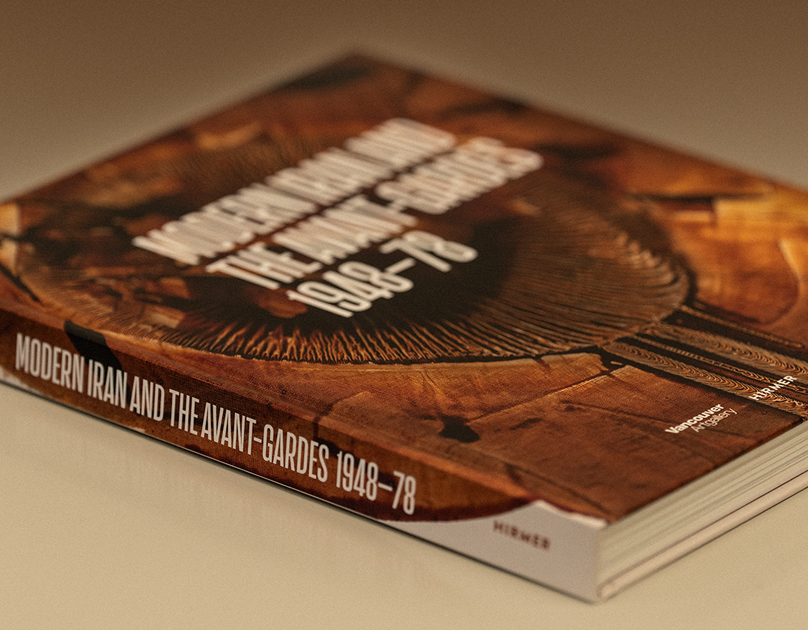
The Vancouver Art Gallery presents
Modern Iran and the Avant-Gardes, 1948–78,
December 11, 2026 to May 2, 2027
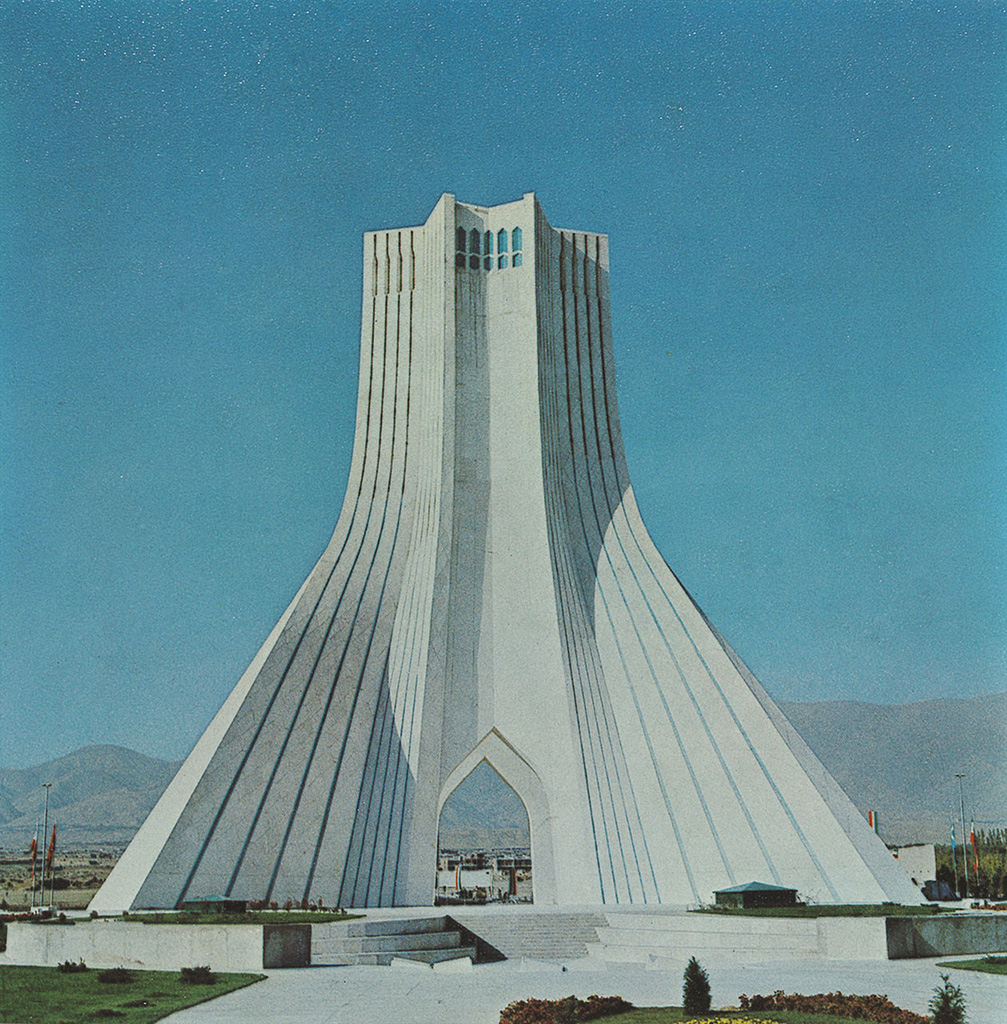
Hossein Amanat, Shahyad Tower (now Azadi Tower), Tehran, Iran, 1971, Photo: Courtesy of Hossein Amanat
What does it mean for a culture with centuries of artistic history to become modern?
For Iranian artists working in the three decades after the Second World War, the question was neither theoretical nor easily answered. Modernity was arriving rapidly, accompanied by urban growth, new technologies, international exchange and sweeping political change. At the same time, Iran possessed an artistic and intellectual inheritance too deep and distinctive to be left behind. The result was not a simple choice between tradition and progress. It was a period of extraordinary experimentation.
Modern Iran and the Avant-Gardes, 1948–78, an exhibition organized by the Vancouver Art Gallery and guest curated by Pantea Haghighi, turns its attention to this complicated and fertile moment. Bringing together approximately 80 works by more than 30 influential artists, the exhibition traces the development of an Iranian modernism that emerged through painting, sculpture, photography, drawing, mixed media, architectural documentation and ephemera.
A Modernism of Its Own
More importantly, the exhibition offers a way of understanding modernism beyond the familiar centres of Paris, London and New York.
Iranian artists were never merely importing a Western aesthetic. They were absorbing international ideas, questioning them, resisting some and transforming others. Cubism, Abstract Expressionism and other modernist movements entered into conversation with Persian calligraphy, poetry, mythology, Islamic architecture, craft traditions and folk culture. What emerged from that exchange was neither wholly Western nor conventionally traditional. It was distinctly Iranian.
That distinction matters. For much of the twentieth century, histories of modern art were written as though innovation travelled outward from Europe and North America toward the rest of the world. The work gathered in Vancouver tells a far more complex story.
Modernism was not a single language exported from one cultural centre. It developed differently wherever artists confronted their own histories, ambitions and changing societies.
Iran offers a particularly compelling example because its artistic transformation unfolded amid profound political tensions.
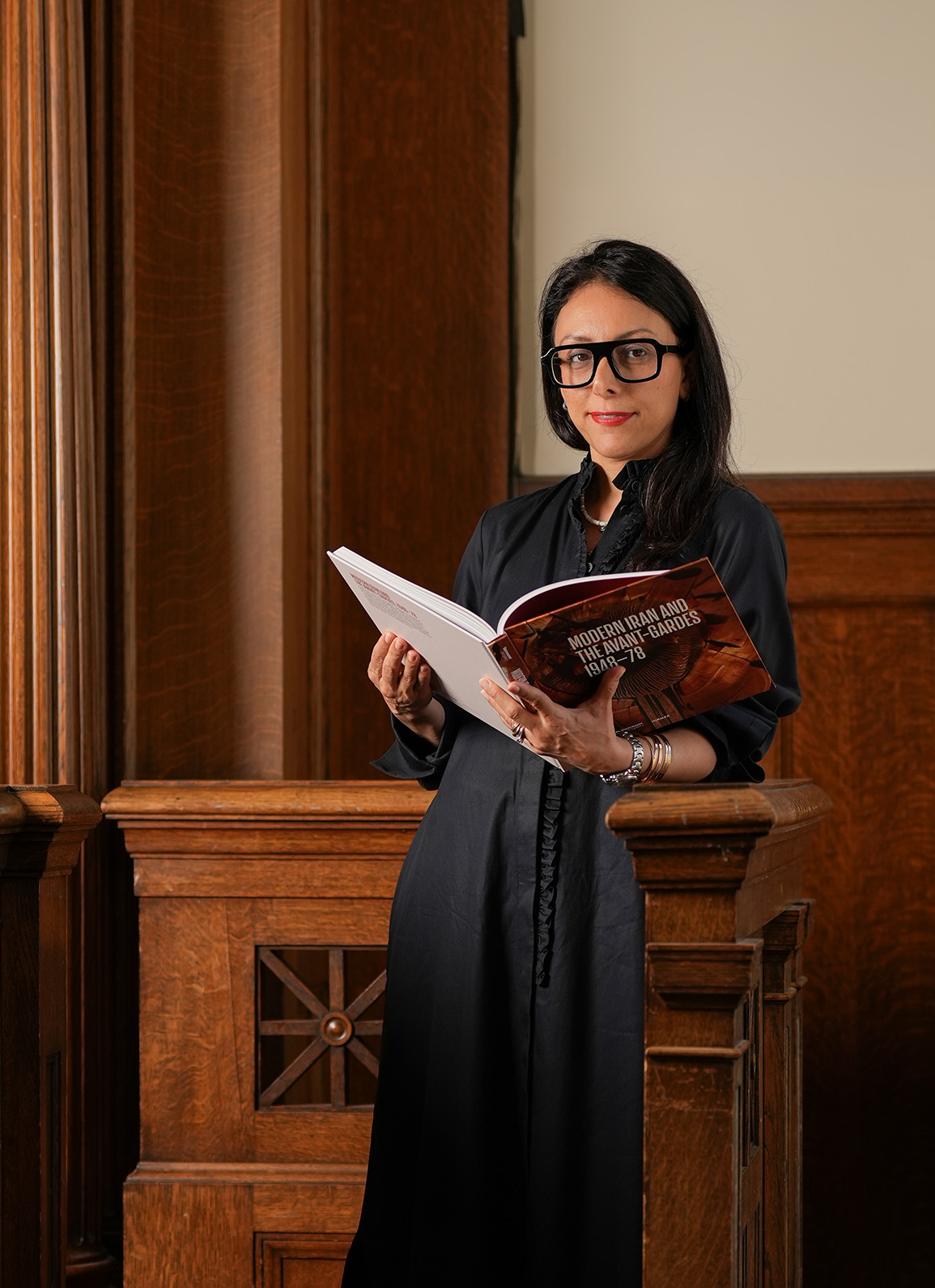
Pantea Haghighi
Guest Curator at the Vancouver Art Gallery
Politics Enters the Studio
One of the defining events of the period was the 1953 coup d’état. Before the coup, Prime Minister Mohammad Mosaddegh’s government had emphasized Iranian sovereignty in the face of foreign interference.
Questions of independence and national identity inevitably entered cultural life as well. Some artists began reconciling international modernist forms, including Cubism, with visual elements that were recognizably Iranian.
After 1953, the contradictions multiplied. Western influence expanded as Iran underwent rapid modernization, while state support helped modern art and architecture flourish. Yet rapid development existed alongside political repression and growing resistance to both Western influence and the direction in which the country was changing.
For artists, this was fertile but unstable ground.
How could a painting be modernist without surrendering its cultural memory? Could abstraction carry a specifically Iranian identity? Was tradition something to preserve, something to reject, or material from which an entirely new visual language could be constructed?
There was no single answer, and the strength of the period lies partly in that refusal of uniformity.
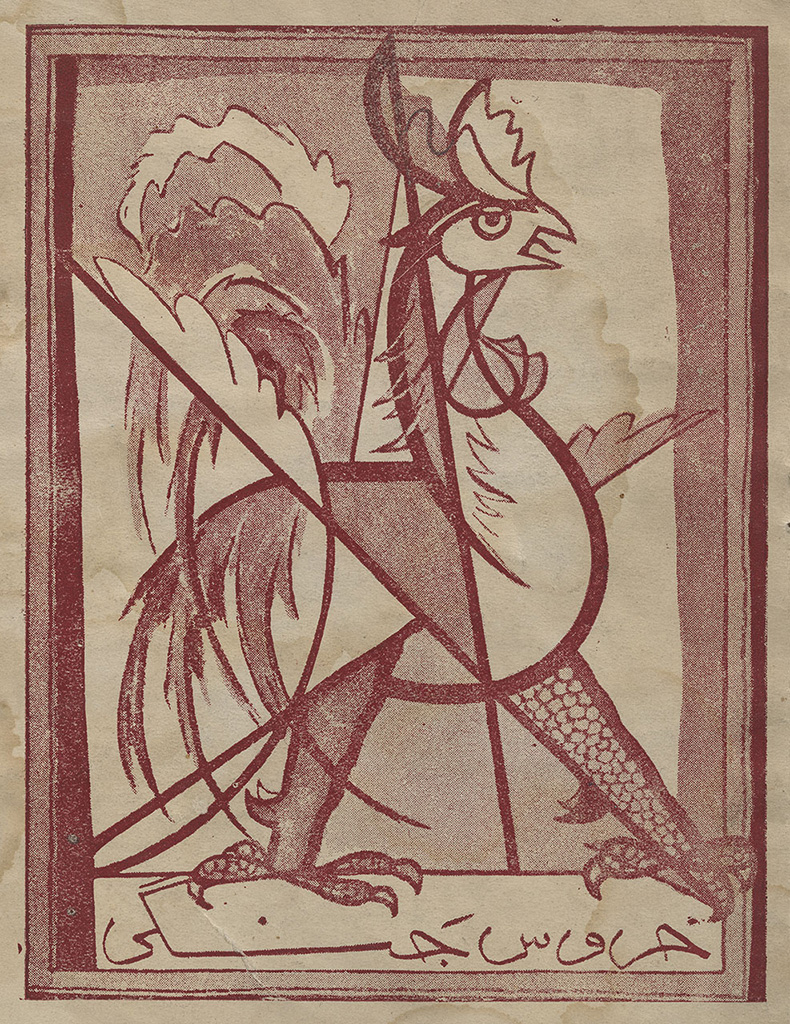
Jalil Ziapour with Gholam Hossein Gharib and Hassan Shirvani, The Fighting Rooster Association, 1948, magazine, Collection of Ali Bakhtiari, Photo: Vancouver Art Gallery
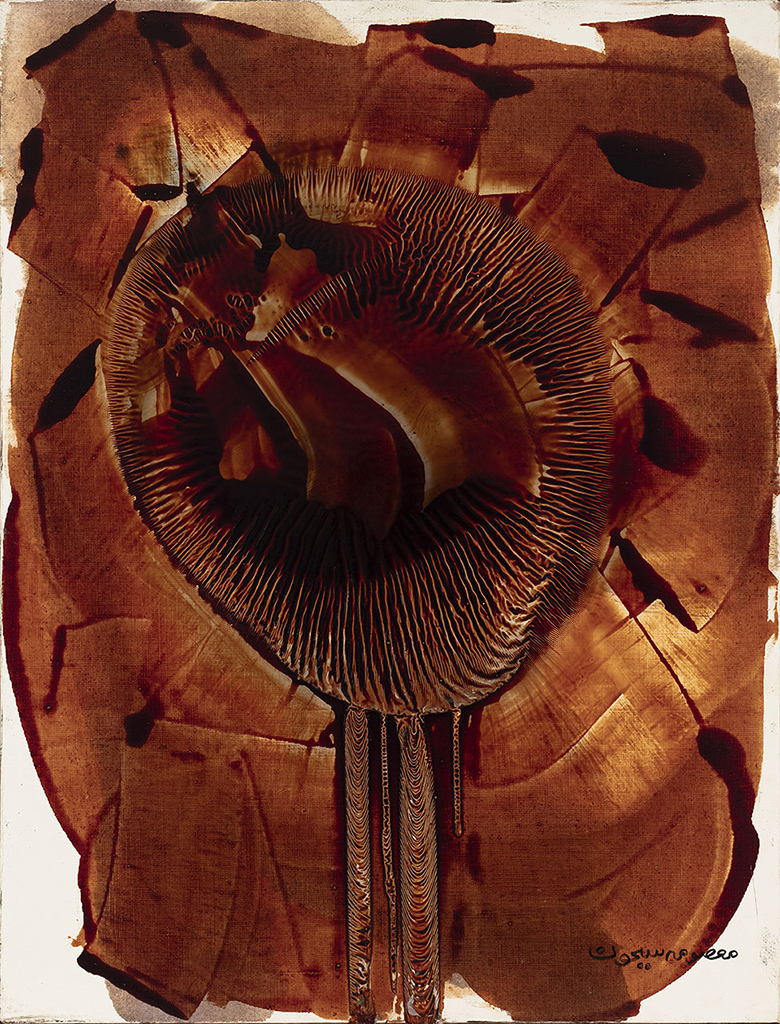
Massoumeh Seyhoun, Composition #13, 1967, enamel and lacquer on canvas, Grey Art Museum, New York University Art Collection, Gift of Abby Weed Grey, G1975.113, Photo: Courtesy of the Grey Art Museum, New York University
Tradition as a Language of Experiment
Artists moved freely between cultural vocabularies. Some discovered pathways into abstraction through forms already embedded within Iranian visual culture. Calligraphy, for example, could be liberated from its literary function and approached through gesture, rhythm, repetition and movement. Behjat Sadr, Reza Mafi and Seyed Mohammad Ehsaey each found ways of bringing the expressive possibilities of writing into a modern pictorial language.
Elsewhere, geometry provided another bridge between histories. Monir Shahroudy Farmanfarmaian transformed the mirrored surfaces and geometric traditions associated with Iranian shrines and palaces into mesmerizing modern compositions. The resulting works feel simultaneously ancient and radical, disciplined and luminous.
By the mid-1960s, another tendency had become increasingly visible. Artists such as Mansour Ghandriz, Parviz Tanavoli and Faramarz Pilaram drew from folk culture, traditional craft and vernacular imagery, treating cultural inheritance not as an obstacle to modernity but as a source of invention.
This neo-traditional approach did not attempt to recreate an idealized past. Its importance came from the opposite impulse: traditional material was taken apart, reinterpreted and placed within an entirely new artistic context.
Other artists resisted belonging to a particular school altogether. Their work was shaped more strongly by individual vision, personal experience and international encounters. Together, these parallel directions reveal just how inadequate it would be to describe Iranian modernism as one movement with a single aesthetic.
The exhibition’s scope makes those differences visible.
Names now widely associated with twentieth-century Iranian art appear alongside artists whose contributions remain less familiar to international audiences. Parviz Tanavoli, Charles Hossein Zenderoudi, Marcos Grigorian, Bahman Mohassess, Sohrab Sepehri, Siah Armajani and Iran Darroudi are presented within a broader constellation that includes figures from painting, sculpture, architecture and other disciplines.
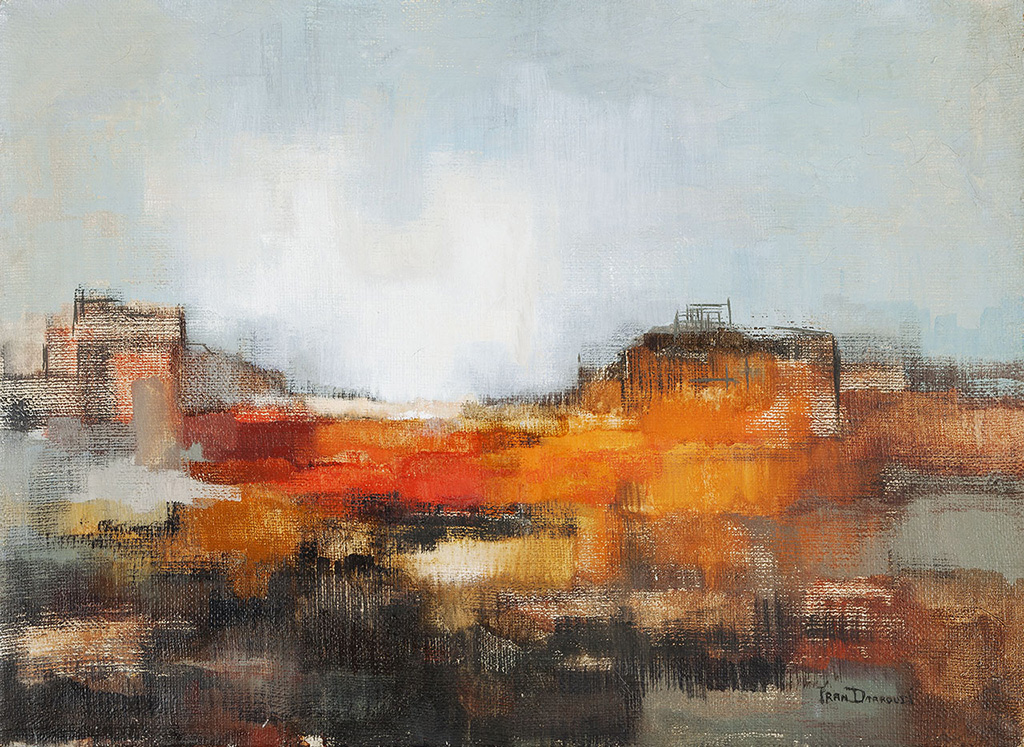
Iran Darroudi, Untitled, c. 1960, oil on burlap, Collection of Houman M. Sarshar, Photo: Courtesy of Houman M. Sarshar
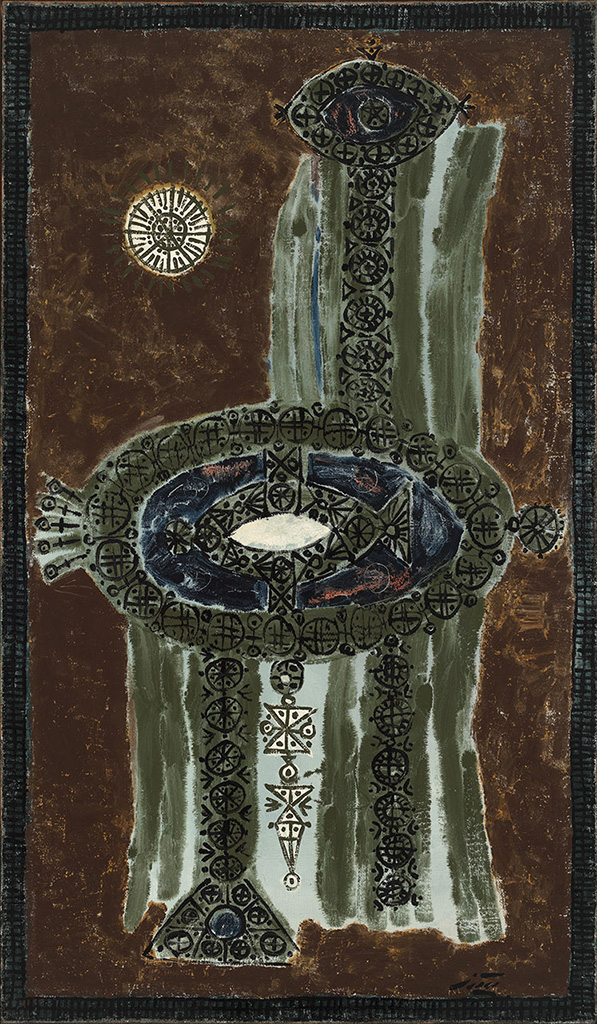
Mansour Ghandriz, Simurg, c. 1961–64, oil on burlap, Grey Art Museum, New York University Art Collection, Gift of Abby Weed Grey, G1975.94, Photo: David Brunetti Photography