
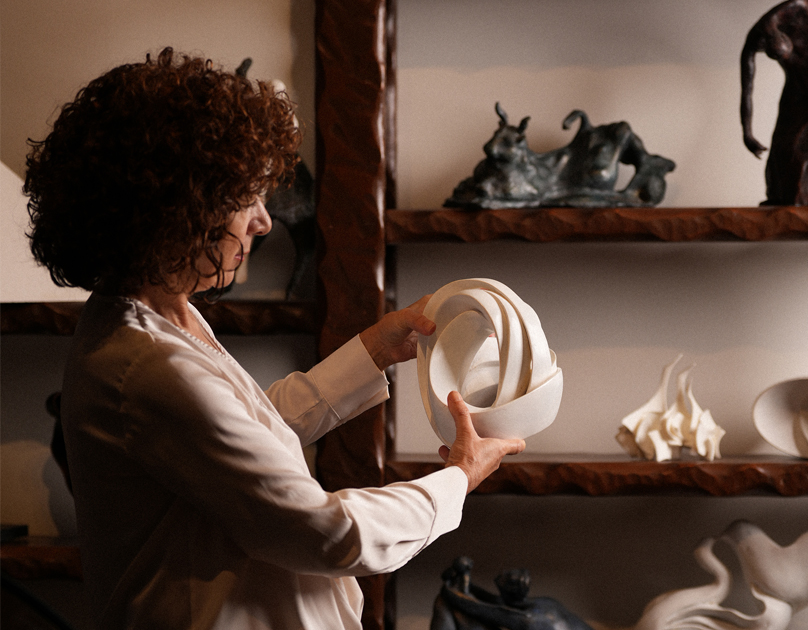
“The concerns that shape my figurative work, silence, resilience, longing, and the fragile hope for peace, remain present here, but in another language.”
Parvaneh Roudgar
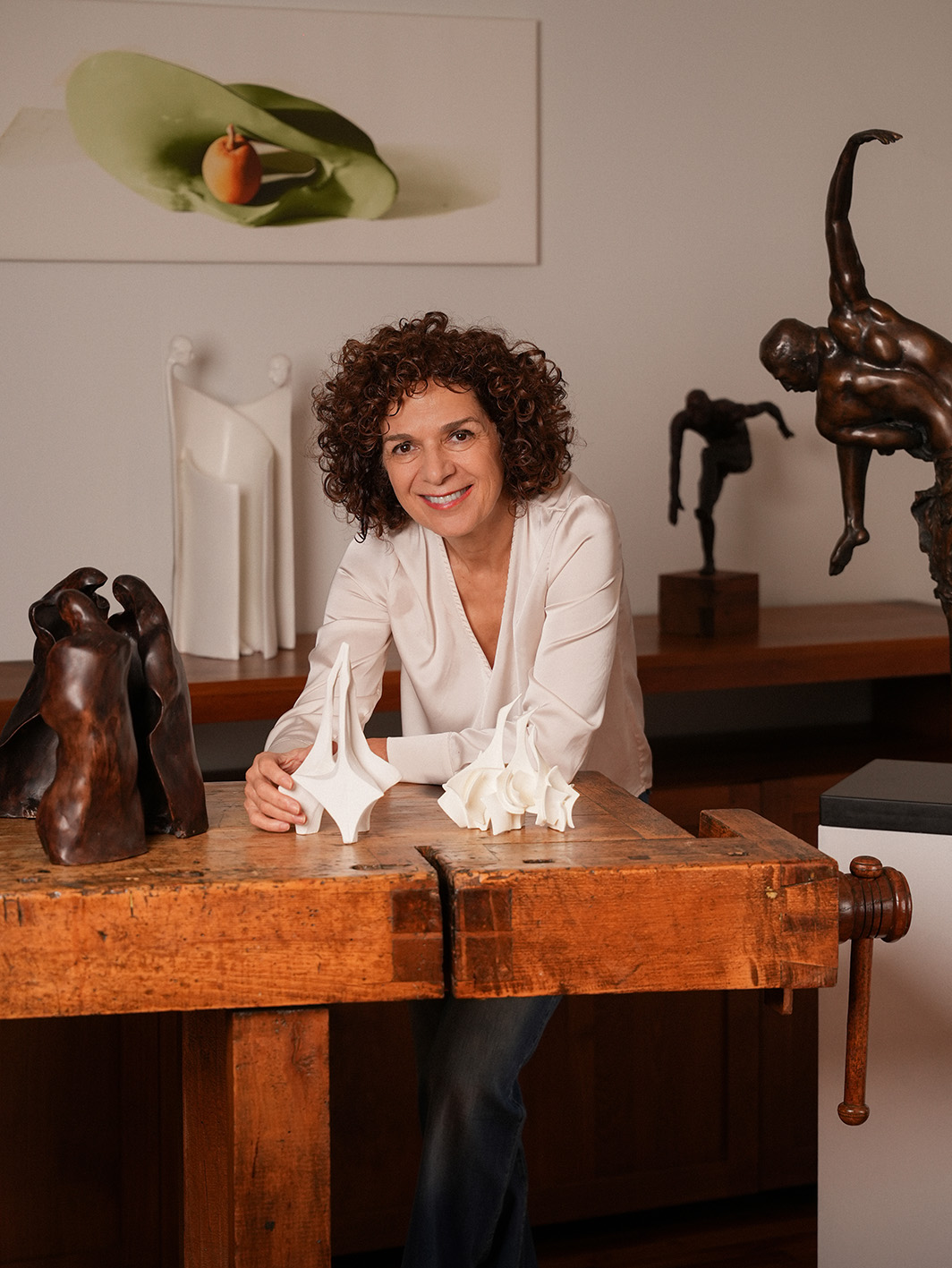
Parvaneh Roudgar is an artist whose trajectory has been shaped not merely by academic training, but by a life lived across cultures, geographies, and diverse human experiences. Her works reflect a deep engagement with cultural memory, migration, identity, and the relationship between human beings and nature, concepts that, over more than three decades of professional practice, have crystallized into a personal, mature, and coherent sculptural language.
Roudgar’s artistic journey began in 1984 with her move to Italy, where she pursued formal training within one of the world’s most enduring sculptural traditions. Her years in Florence, a city where art history is embedded not only in museums, but also in architecture, urban space, and daily life, played a foundational role in shaping her artistic vision. Studying with masters such as Antonio Di Tommaso and Marcello Fantoni provided her with a grounding in technique, anatomy, composition, and a deep respect for material. Yet Florence was more than a site of technical instruction; it was the place where sculpture emerged as a language of thought and emotion, a medium capable of articulating complex human experience.
Between Heritage & Migration
“Here, form becomes a vessel for experience: a silent motion shaped into presence.”
Alongside her classical training in Italy, Iranian cultural heritage has played a central role in shaping Roudgar’s visual and conceptual world. From the outset of her artistic education, she was profoundly influenced by ancient Iranian art, particularly early ceramics and symbolic motifs such as the goat, the sun, and rain. These symbols, associated with fertility, life, nature, and continuity, appear in her work not as decorative references but as carriers of historical and cultural memory. Interwoven with her Western sculptural education, these elements gradually became integral to a distinctly personal sculptural vocabulary.
Iranian architecture has also exerted a lasting influence on Roudgar’s formal sensibility. The balance, repetition, rhythm, and patience embedded within historic Iranian structures inspired a series of architectural and volumetric works. In these pieces, volume functions not merely as form but as a vessel of time and memory. For Roudgar, Iranian architecture embodies an art of continuity, an enduring presence that finds resonance in many of her sculptures, particularly in their relationship to space, silence, and stillness.
After sixteen years of living and working in Italy, Roudgar immigrated to Canada, a move that marked a significant turning point in her artistic life. This transition placed her within a multilayered multicultural environment, exposing her to diverse perspectives and ways of thinking. Experiencing a culture grounded in tolerance, coexistence, and dialogue among differences became a lived reality rather than an abstract ideal. This encounter prompted a deeper reconsideration of roots, identity, and the meaning of belonging, an inquiry that had a profound impact on her artistic worldview.
Women, Conflict,& the Veil
More than two decades ago, amid escalating social and political crises in the Middle East, a new phase emerged in Roudgar’s practice. These developments, viewed through the lens of her lived experience as a Middle Eastern woman, deeply affected the direction of her work. During this period, questions of the body, identity, and women’s presence within contexts of conflict and instability became increasingly central to her artistic concerns.
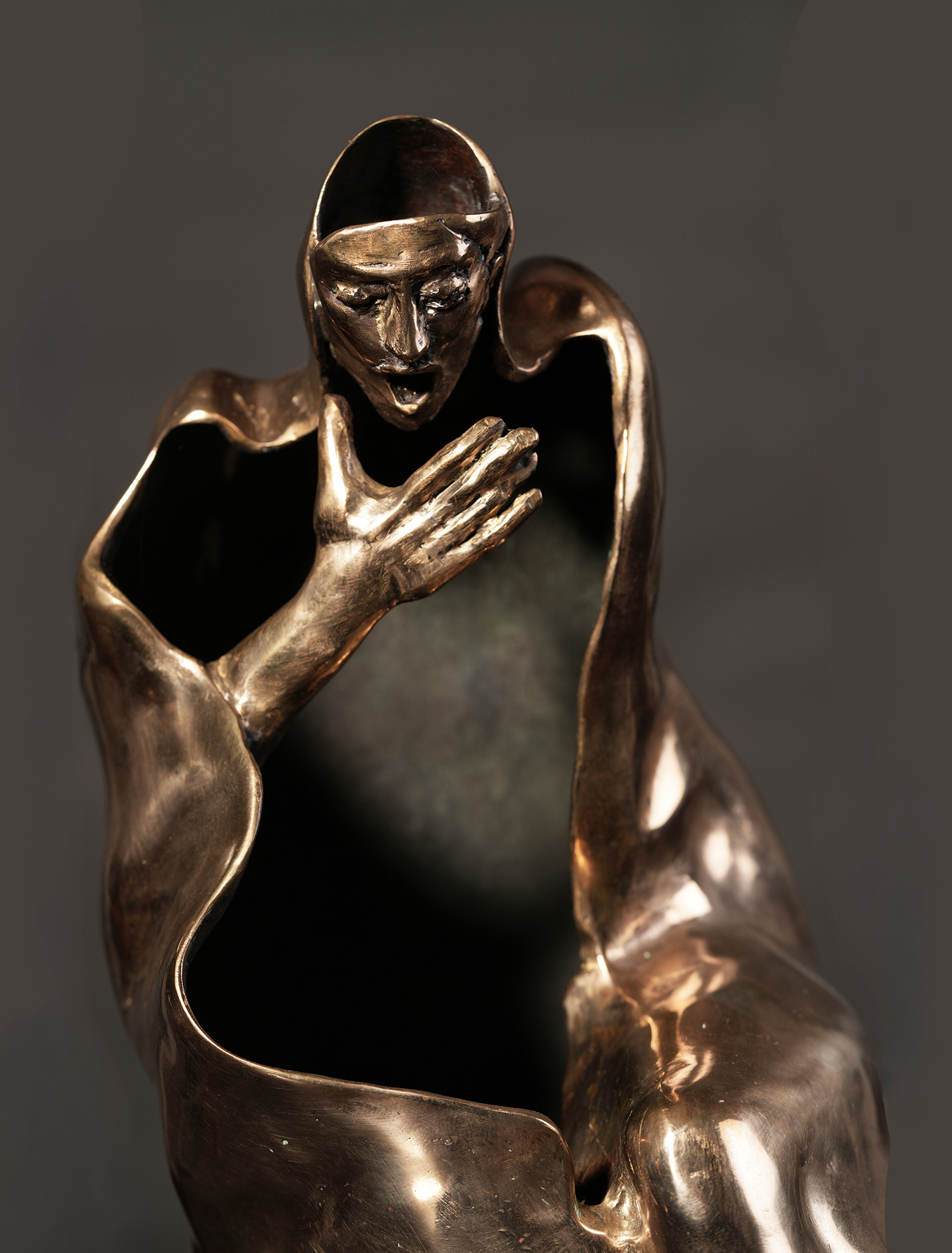
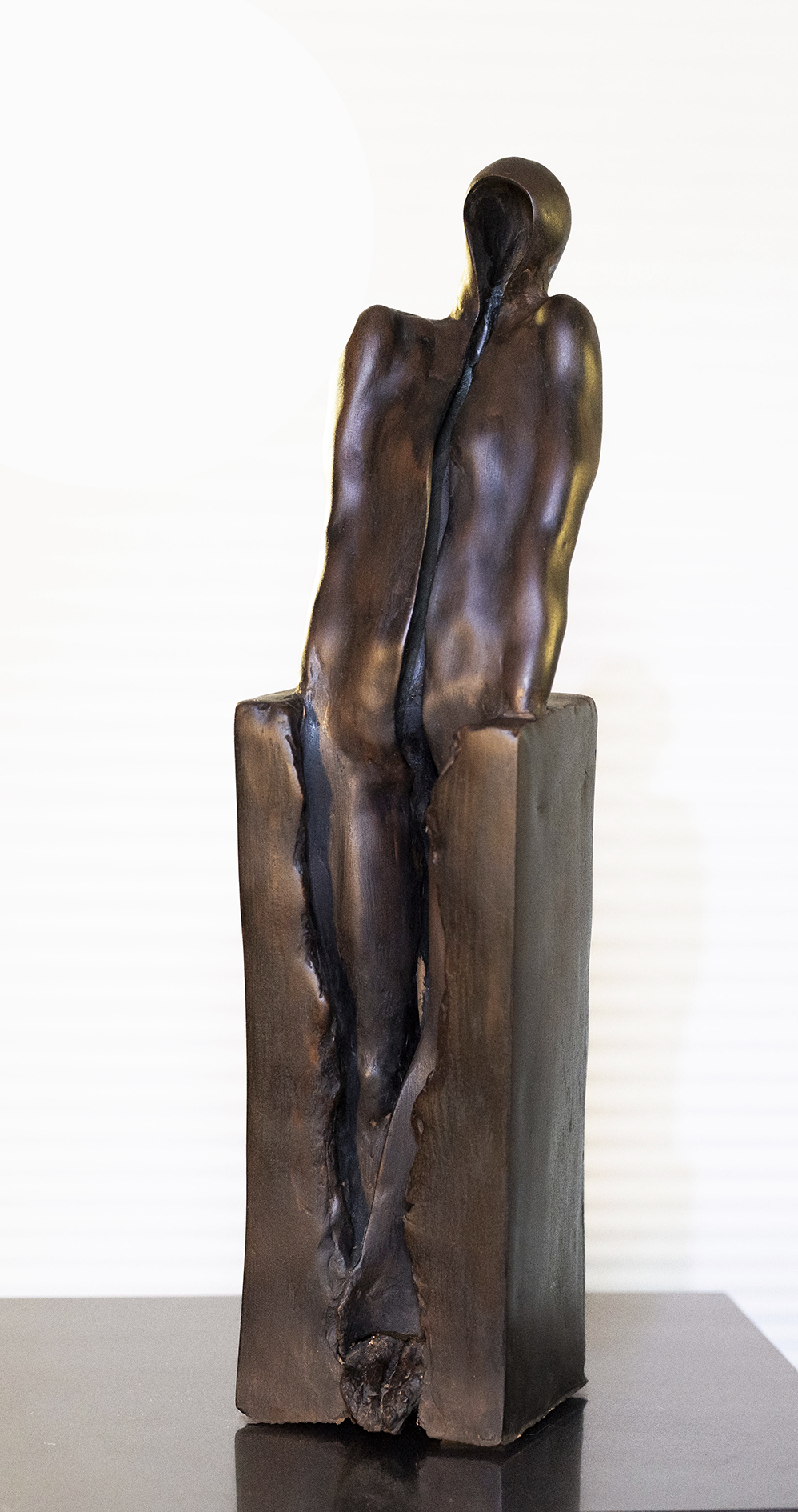
To articulate these experiences, Roudgar turned to one of the most complex and culturally charged symbols associated with Middle Eastern women: the veil. Rather than representing the female body or face directly, she transformed the chador (veil) into a living sculptural form. Through its movements, folds, and moments of release, the veil becomes a vessel for the female voice, a voice that carries motherhood, endurance, pain, and hope. In these works, the veil does not signify silence or passivity; instead, it becomes a site of expression and agency. Roudgar does not seek to judge the veil itself but instead suggests that while political or social systems may attempt to regulate women’s bodies through enforced dress, they cannot conceal women’s inner lives, emotions, resilience, and presence, which continue to manifest even within the shadow of the veil. This approach allowed her to translate a layered and nuanced experience of womanhood into sculptural form without resorting to direct narrative or overtly didactic statements.
Artist's Statement
Middle East Women
The chador (veil) became a language for me, a language to speak what has not been spoken, to loosen inner knots, and to give voice to the weight of history and the identity of Middle Eastern women.
In its movement, in twists, stillness, and release,
the voices of women flow: voices of motherhood, patience, pain, hope, and long-held silences.
I am myself a Middle Eastern woman, with all her history, identity, pain, and beauty. This body of work reflects years of living, migration, experience, my love for Iran, and the inner voices of women to whom history has rarely given the chance to speak.
I transformed the chador into a figure, a figure without a body, because even without a face or form, and even when power attempts to erase them, it cannot conceal women’s emotions, memories, and history.
Geometric Sculpture
I have always been deeply influenced by Iran’s historic architecture, an architecture that is not merely structure, but narrative, rhythm, and the spirit of a civilization. From turquoise domes to muqarnas, from elongated arches to tilework that covers walls like celestial carpets, these were never just visual beauty for me, but a language of geometry, balance, and spirituality.
In Iran’s historic architecture, everything is in its place: each line continues another, each curve responds to another curve, and every geometric motif reflects an underlying system of thought.
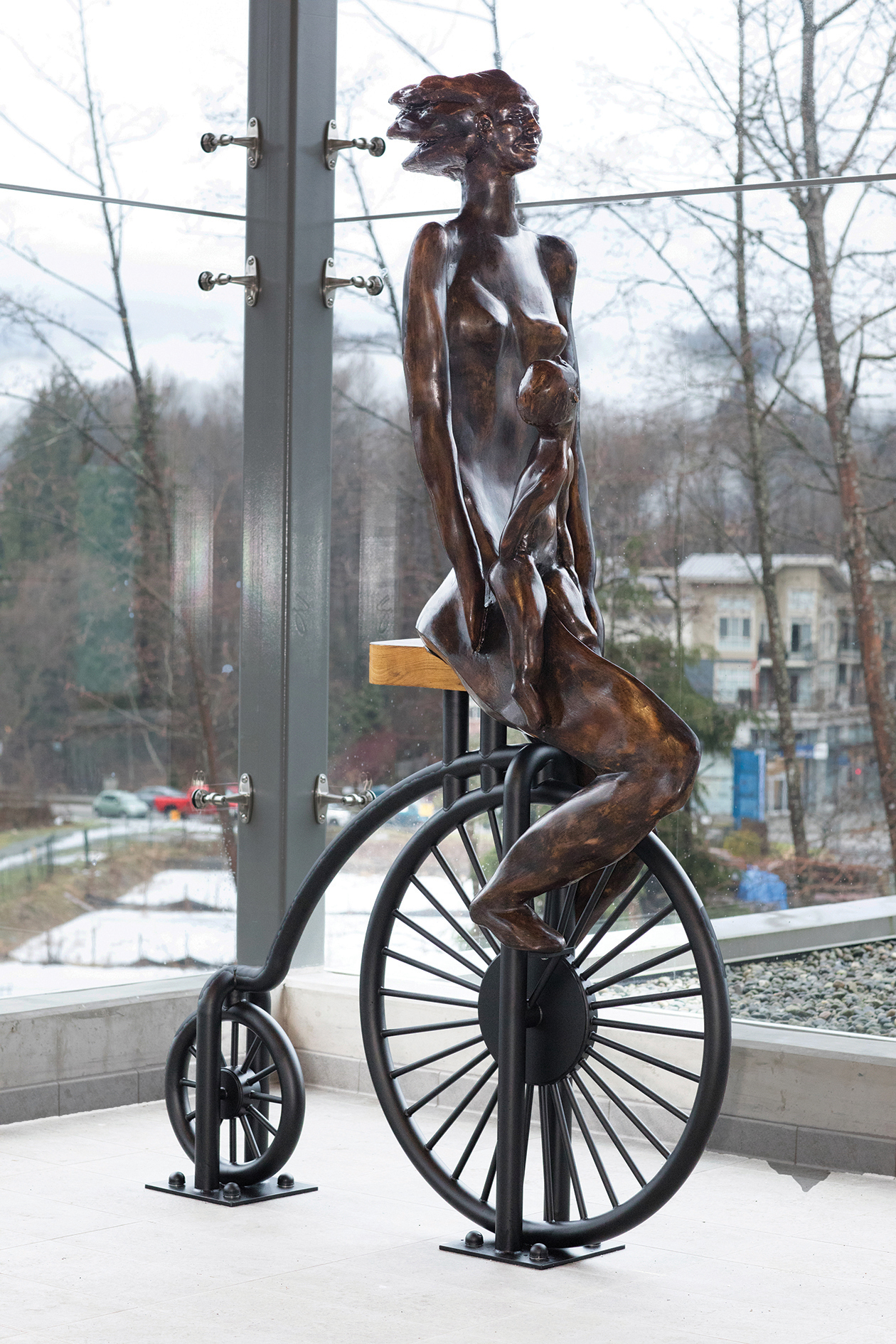
Mother and Child on A Bike — 2016
Permanent installation at Inlet Skytrain Station, Port Moody ,BC,Canada
Created for the Inlet SkyTrain Station, Mother and Child introduces gentle humor into a public transit space. The mother does not hold the child with her hands; instead, she looks forward confidently, while the child gazes at her with curiosity and trust. The sculpture offers commuters a moment of lightness and subtly encourages the use of public transportation and bicycles as part of everyday urban life.
Public Art & Collective Memory
Alongside her studio practice, Parvaneh Roudgar has realized numerous public art projects. One significant example is a body of works created concurrently with the beginning of her migration to Vancouver, a body of work in which the sculpture Migration (permanently installed in 2020 at the Currumbin Wildlife Sanctuary on Australia’s Gold Coast) stands as one of its most important realizations. These works were shaped by the artist’s observation of Canadian seabirds, whose light, far-reaching flights across vast, borderless oceans became metaphors for movement, transition, and the search for new horizons. In this body of work, migration is articulated not merely as departure from a place, but as a journey grounded in hope, survival, and an organic relationship between humans and nature.
Another notable public work, Mother and Child, was commissioned by the City of Port Moody and installed in 2017 as part of the Evergreen Project at the Inlet SkyTrain Station. This sculpture exemplifies Roudgar’s ability to create works that function simultaneously on a public and deeply emotional level, articulating a universal bond that transcends culture, language, and geography.
Over the course of more than thirty-eight years, Parvaneh Roudgar has participated in numerous national and international exhibitions across North America, Europe, Asia, and Australia. Her works exist not only within gallery contexts but also within public spaces, where they engage diverse audiences and become part of the collective memory of place.
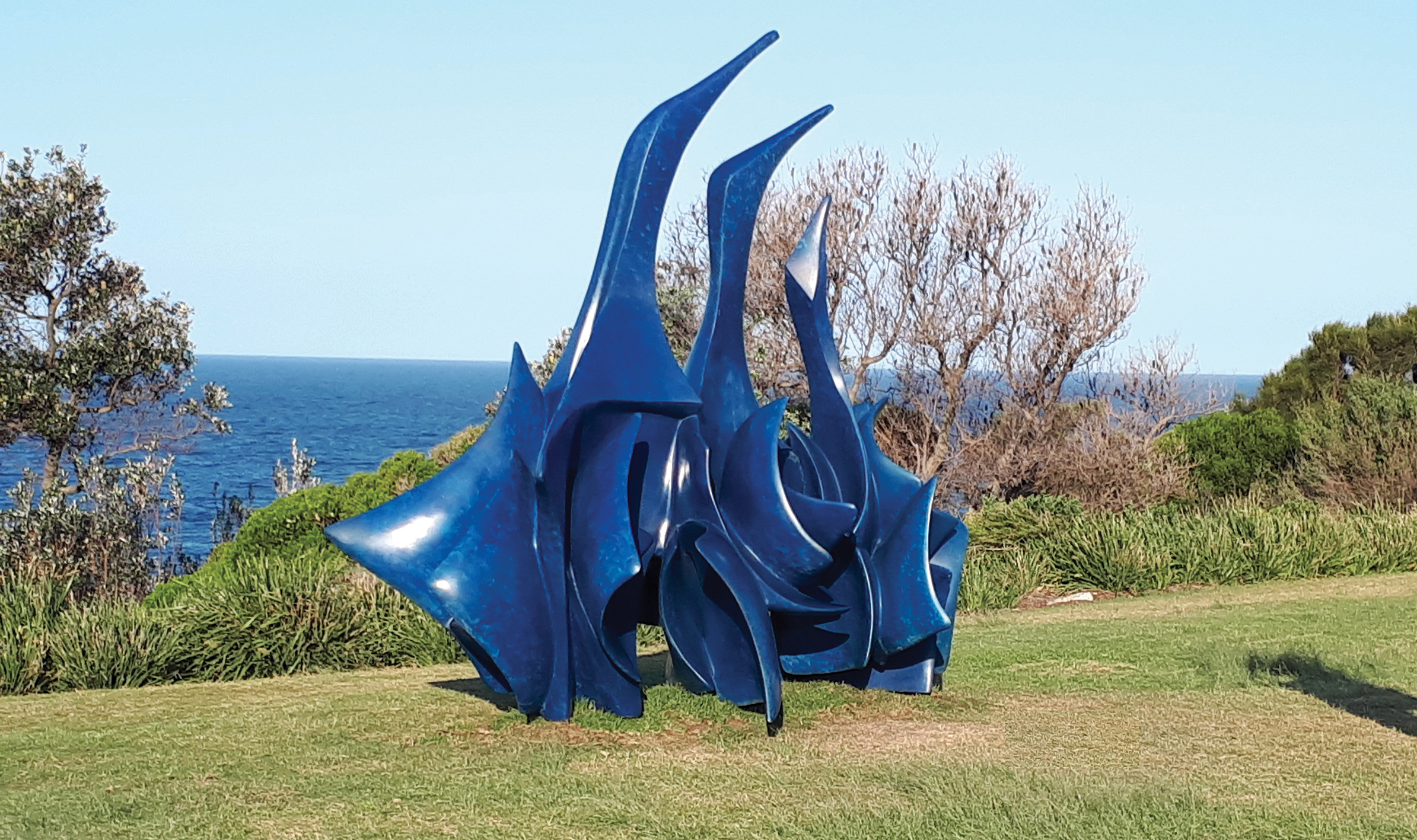
Migration — 2018
Permanent installation at Currumbin Wildlife Sanctury,Gold Coast ,Australia
Practice & Philosophy
Teaching has also played a vital role in shaping Roudgar’s professional identity. Since 1994, she has taught sculpture in Florence and Vancouver, guiding multiple generations of students through both technical foundations and the cultivation of an authentic artistic voice.
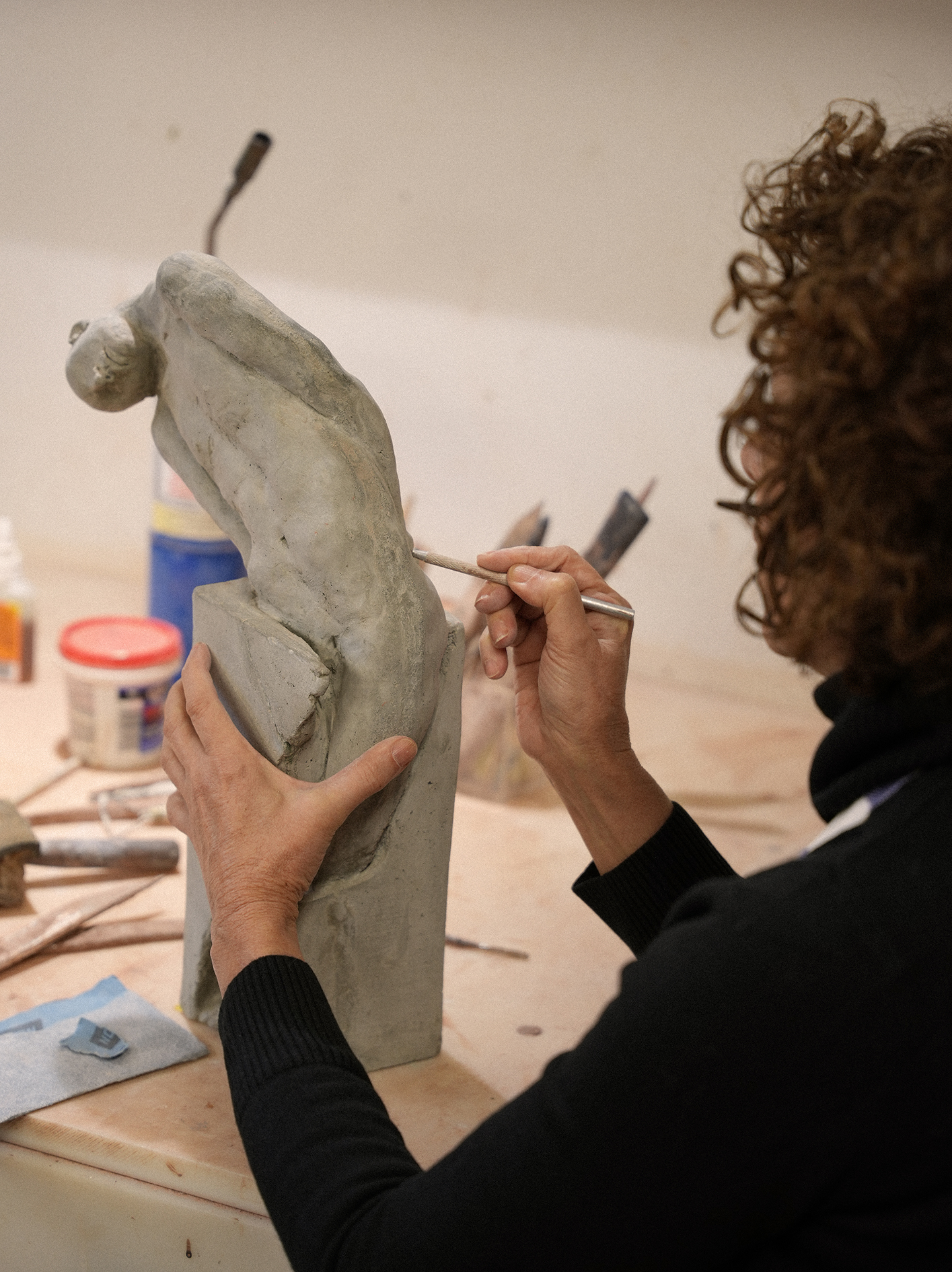
In terms of material, Roudgar works with a range of media, yet what unifies her practice is a deep respect for material and process. Surface textures, traces of the hand, and deliberate moments of incompletion all become part of the work’s narrative, lending her sculptures a living, human quality.
Roudgar’s works are held in significant collections, including the Salsali Private Museum in Dubai, underscoring the international recognition and impact of her practice. Nevertheless, what most clearly defines her artistic path is her commitment to personal integrity and sincerity in creation.
In a contemporary world dominated by speed, consumption, and fleeting imagery, Parvaneh Roudgar’s sculptures offer an invitation to pause, touch, and reflect. For Roudgar, sculpture is not merely a profession but a way of living and thinking, an ongoing dialogue between individual and collective experience, memory and place, and humanity and the surrounding world.
Selected Abstract Sculptures
The concerns that shape her figurative work, silence, resilience, longing, and the fragile hope for peace, remain present here, but in another language. Through rhythm, balance, and the invisible architecture of feeling, these abstract forms trace the weight of displacement, the tension between chaos and calm, and the quiet pulse of endurance. It is a way of allowing meaning to breathe, to appear through rhythm, balance, tension, and release rather than through narrative or representation. Here, form becomes a vessel for experience: a silent motion shaped into presence.
Selected Public Art Sculptures
Parvaneh Roudgar’s public artworks explore human connection, memory, and shared space through sculptural forms that are both intimate and accessible. Rooted in her cross-cultural background and classical training, her installations engage diverse communities while responding sensitively to their architectural and social environments. Through durable materials and expressive form, her public art invites reflection, dialogue, and a sense of belonging within the public realm.